
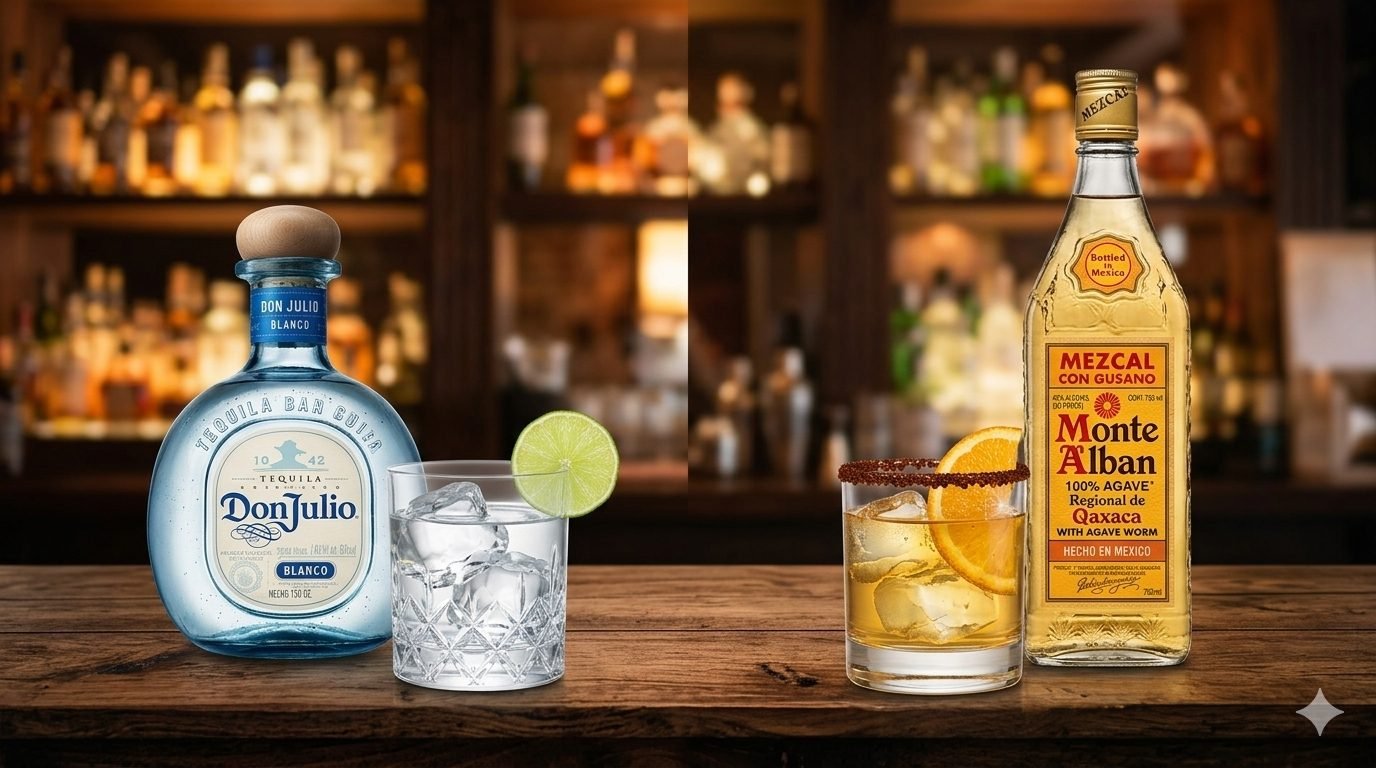
Tequila vs Mezcal: What’s Actually the Difference?
Tequila vs mezcal: learn how these Mexican agave spirits differ in agave, origin, production and flavour, plus what beginners should order first.
Tequila and mezcal are often placed next to each other on a bar menu.
Both come from Mexico.
Both are made from agave.
Both can be enjoyed neat or used in cocktails.
And both have acquired enough mythology that a beginner can easily assume the difference is simply:
Tequila is for Margaritas.
Mezcal is the smoky one.
That is convenient.
It is also incomplete.
The real difference begins with where the spirits can be produced, which agave they can use and the rules that define each protected category.
Once you understand that, the bottles behind the bar start making considerably more sense.
First: Are Tequila and Mezcal the Same Thing?
No.
Tequila and mezcal are separate regulated Mexican spirits with their own protected production rules and denominations of origin.
They share an important starting point — agave — but that does not make them interchangeable.
Think of them as relatives rather than identical drinks.
Their raw materials, permitted production regions and methods can create very different results in the glass.
What Is Tequila Made From?
Tequila is made specifically from the blue agave:
Agave tequilana Weber blue variety.
Under the official Tequila standard, that is the only agave variety permitted for tequila production.
The agave must also come from authorised areas covered by Tequila’s Appellation of Origin, and production must follow the official Mexican standard.
That specificity is one of the easiest distinctions to remember.
Tequila = blue agave.
What Is Mezcal Made From?
Mezcal is also an agave spirit, but the category is not restricted to blue agave alone.
Different permitted agave species and varieties can be used depending on the mezcal and its production.
This is one reason mezcal can show such a wide range of character.
Different agaves grow differently, mature at different rates and bring different flavours.
So when somebody says “mezcal tastes like this,” they may be describing only a small part of a much broader category.
Where Is Tequila Made?
Tequila can only be produced in authorised areas of Mexico covered by its Appellation of Origin.
Jalisco is the place most strongly associated with tequila, but the protected territory also includes authorised municipalities in other Mexican states.
The important point for a beginner is not memorising every municipality.
It is understanding that tequila is geographically protected.
A blue-agave spirit made anywhere in the world cannot simply call itself tequila.
Where Is Mezcal Made?
Mezcal also has a protected Denomination of Origin covering authorised production areas in Mexico.
Oaxaca is strongly associated with mezcal and is central to its modern identity, but mezcal production is not limited to Oaxaca alone.
As with tequila, origin matters legally as well as culturally.
This is not simply a generic name for any smoky agave spirit.
So Why Does Mezcal Often Taste Smoky?
This is where production becomes important.
Traditional mezcal production can involve cooking agave in earthen pits with heated material before fermentation and distillation.
That process can contribute the smoky character many people associate with mezcal.
But “smoky” is not the complete definition of mezcal.
Some mezcals are intensely smoky.
Others are much more subtle.
You may also find earthy, herbal, mineral, fruity, floral or vegetal characteristics depending on the agave and production.
If your first mezcal tastes like a bonfire, do not assume every mezcal will.
Is Tequila Never Smoky?
Not necessarily.
Production choices can create a wide range of flavours in any spirit.
But obvious smoke is much more strongly associated with many traditional mezcal styles than with mainstream tequila.
Tequila often presents blue-agave character alongside citrus, pepper, herbs, fruit and, when matured in wood, vanilla, spice, caramel or oak.
The categories overlap in some flavour territory, but they are not flavour copies of each other.
Tequila Blanco vs Mezcal: A Useful First Comparison
If you want to understand the difference, comparing an unaged or minimally rested tequila expression with a young mezcal can be useful.
A Blanco tequila keeps the focus on blue agave without extended oak maturation.
A young mezcal can similarly allow the agave and production character to remain central.
Taste them side by side.
Do not immediately search for sophisticated tasting notes.
Ask simpler questions.
Which smells more herbal?
Which feels sweeter?
Which seems smokier?
Which has more pepper?
Which one would you order again?
That is already a useful tasting.
What About Reposado and Añejo Tequila?
Tequila also has recognised maturation classes.
Reposado spends at least two months in contact with permitted wood.
Añejo spends at least one year in qualifying oak containers.
Extra Añejo spends at least three years.
Wood can introduce additional flavours and change texture, making aged tequila a very different experience from Blanco.
So if you compare an Añejo tequila with a young mezcal, you are comparing both category and maturation at the same time.
That can still be enjoyable, but it is not the simplest way to understand the fundamental difference.
Does Mezcal Have Ageing Categories Too?
Mezcal has its own regulated categories and classes, including distinctions related to maturation and production.
But for a beginner, you do not need to memorise the entire legal framework before ordering a glass.
Start with the bottle in front of you.
Ask which agave it uses.
Ask where it is from.
Ask whether it has been matured.
Then taste it.
That information is far more useful at the bar than trying to recite regulations.
Is Tequila a Type of Mezcal?
You may have heard the phrase:
“All tequila is mezcal, but not all mezcal is tequila.”
It is often used as an easy explanation because both are Mexican agave spirits.
For casual conversation, it points toward their shared agave heritage.
But if we are being precise about today’s regulated categories, Tequila and Mezcal have separate denominations, standards and certification systems.
So for ordering and understanding a modern bottle, it is clearer to treat them as distinct protected categories that share an agave family connection.
That avoids turning a useful shortcut into a legal definition.
Which One Is Stronger?
Do not decide from the category name.
Alcohol strength varies by bottle.
A mezcal is not automatically stronger than tequila, and tequila is not automatically lighter.
Check the actual alcohol by volume if strength matters to you.
What can differ is how intense a spirit feels.
Smoke, pepper, alcohol, oak and other flavours can make one glass seem more powerful even when the numbers are similar.
Which Is Smoother?
“Smooth” is one of the most common words used when talking about spirits and one of the least precise.
One person may mean low alcohol burn.
Another means soft texture.
Another means little smoke.
Another means slightly sweeter flavour.
So rather than asking:
“Which is smoother?”
Try:
“Which is less smoky?”
“Which is lighter?”
“Which has less alcohol heat?”
“Which would you recommend for sipping?”
Those questions give the bartender something more useful to work with.
Which Is Better for a Beginner?
Tequila is often the more familiar starting point because many people already know the Margarita and have encountered tequila before.
A good Blanco or Reposado can be an accessible introduction to agave spirits.
But if you enjoy smoky flavours, earthy spirits or trying something less familiar, mezcal may immediately appeal to you.
There is no required order.
You do not need to “graduate” from tequila to mezcal.
They are different things worth exploring on their own terms.
If You Like Whisky
You may enjoy aged tequila because Reposado or Añejo can give you familiar oak-related reference points such as vanilla, spice and wood.
Mezcal may appeal for a completely different reason.
Some whisky drinkers who enjoy peated Scotch are naturally curious about mezcal’s smoky reputation.
Just remember that peat smoke and agave cooked through traditional mezcal processes are not the same flavour.
Similarity can be a doorway, not a definition.
If You Like Gin
You may enjoy the herbal and botanical side of agave spirits.
Blanco tequila can show peppery, vegetal, citrus and herbal character.
Some mezcals can be highly aromatic, earthy or botanical in their own way.
Try them neat in small amounts before covering them with mixers.
You may find more complexity than expected.
Tequila in a Margarita
The Margarita remains one of tequila’s most important cocktails for good reason.
Tequila, citrus, sweetness and orange liqueur can create a drink that is refreshing while still allowing the base spirit to matter.
For someone new to tequila, a well-balanced Margarita is a very easy entry point.
It is familiar without making the tequila disappear.
Can You Make a Margarita With Mezcal?
Yes, mezcal can be used in Margarita-style drinks, creating a noticeably different result.
The agave connection remains, but mezcal can introduce smoke, earthiness and other characteristics depending on the bottle.
Some bars use mezcal entirely.
Others split the base between tequila and mezcal.
If you already like Margaritas and want to understand mezcal, this can be an approachable bridge.
Tequila vs Mezcal for Sipping
Both can be sipped.
Tequila does not need to be shot.
Mezcal does not need to be hidden inside a cocktail.
Take a small pour.
Smell it gently.
Sip.
Give the spirit a moment before deciding what you think.
With tequila, notice the agave, pepper, fruit, herbs and possible oak.
With mezcal, notice the agave first rather than searching only for smoke.
The more you focus on “Is this smoky?” the easier it is to miss everything else.
What About Salt, Lime and Orange?
Tequila is commonly associated with salt and lime, particularly when consumed as a shot.
Mezcal is sometimes served with orange and seasoned salt.
These accompaniments can be enjoyable, but they are not mandatory definitions of either spirit.
If you are trying to understand a bottle, taste the spirit first.
Then add whatever accompaniment you genuinely enjoy.
Tequila and Food
Tequila can work very naturally with food.
Blanco can complement fresh, spicy, citrus-driven dishes.
Reposado can work with grilled flavours, tacos and richer meats.
Añejo can stand beside deeper savoury dishes or be enjoyed after dinner.
Its versatility is one reason tequila works beyond the shot glass.
Mezcal and Food
Mezcal’s earthy, smoky and agave-driven characteristics can work well with grilled food, spice, roasted flavours and dishes with enough character to meet the spirit.
But the specific mezcal matters.
A delicate expression and a heavily smoky one will not behave the same way.
There is no universal “mezcal pairing.”
Taste the spirit and think about the food in front of you.
Tequila, Mezcal and Tacos
This is an obvious place to experiment.
Tacos can bring acidity, chilli, grilled meat, herbs, fat and fresh garnishes.
Blanco tequila can keep things bright.
Reposado can bring additional richness.
Mezcal can introduce smoke and earthiness.
A Margarita can refresh the palate.
You could spend an entire evening testing combinations and still not need to turn it into a formal tasting.
Tequila, Mezcal and Burgers
Aged tequila can work surprisingly well with a beef burger because oak, spice and richer agave flavours can stand beside grilled meat and cheese.
Mezcal can also complement charred and smoky flavours.
Or you can go in the opposite direction and order a bright tequila cocktail to cut through the richness.
There is no rule saying agave spirits only belong with Mexican food.
How to Order Tequila If You are a Beginner
Try:
“I am new to tequila. Do you have a good Blanco to start with?”
“I usually drink whisky. Would you recommend Reposado or Añejo?”
“I would like a Margarita that is not too sweet.”
“Can I try something that is 100% agave?”
Those questions are enough.
You do not need to know every producer.
How to Order Mezcal If You are a Beginner
Try:
“I have never really had mezcal. What is a good introduction?”
“I do not want something overwhelmingly smoky.”
“What agave is this made from?”
“Would you recommend this neat or in a cocktail?”
Again, useful questions beat pretending to know.
A bartender should help you explore the category, not test you on it.
Do not Choose by the Worm
The famous “worm” associated with some agave-spirit bottles has created decades of confusion.
It is not what defines mezcal.
And it certainly is not the distinction between tequila and mezcal.
If you want to understand the categories, focus on agave, origin, production and the actual spirit.
The novelty at the bottom of a bottle is not your best teacher.
Tequila and Mezcal at a Bar
A good bar list does not need hundreds of agave spirits to give you a useful introduction.
A few different expressions can already show how broad the category can be.
Try a Blanco tequila.
Try a Reposado.
Try a mezcal.
Compare.
If you enjoy one, ask what makes it different from the others.
That is how a drinks list becomes useful rather than intimidating.
At The Bank Bar & Burgers
Tequila is already part of the way people drink at The Bank — from Margaritas to neat pours and evenings where tequila joins whisky, gin, vodka, wine and beer around the same table.
Our approach is not to make people feel they need specialist knowledge before ordering.
If you know exactly what you want, order it.
If you do not, ask.
And if tequila is familiar but mezcal is new territory, understanding the difference gives you a much better starting point than simply assuming one is the smoky version of the other.
The Difference in One Minute
Tequila and mezcal are both Mexican agave spirits, but they are distinct protected categories.
Tequila uses only Agave tequilana Weber blue variety and must come from authorised Tequila regions.
Mezcal can use multiple permitted agave species and varieties within its own protected production areas.
Traditional mezcal production often creates the smoky character associated with the spirit, but smoke is not the complete definition of mezcal.
Tequila includes Blanco, Reposado, Añejo and other recognised classes.
Both tequila and mezcal can be sipped or used in cocktails.
Neither has to be consumed as a shot.
What Should You Order First?
If you already like Margaritas, start with tequila.
Try the Margarita.
Then try a small amount of the tequila on its own.
If you are curious about smoke, earthiness and different agave varieties, try mezcal.
If both interest you, order small pours and compare them.
Do not worry about deciding which one is “better.”
That is not the interesting question.
The interesting question is whether understanding the difference makes you curious enough to try another glass.
That is usually where the fun starts.
If you are just starting to explore agave spirits, our beginner's guide to tequila is a good place to start, alongside our guide to classic cocktails. Explore our menu and promotions next time you visit.
The interesting question is whether understanding the difference makes you curious enough to try another glass.