
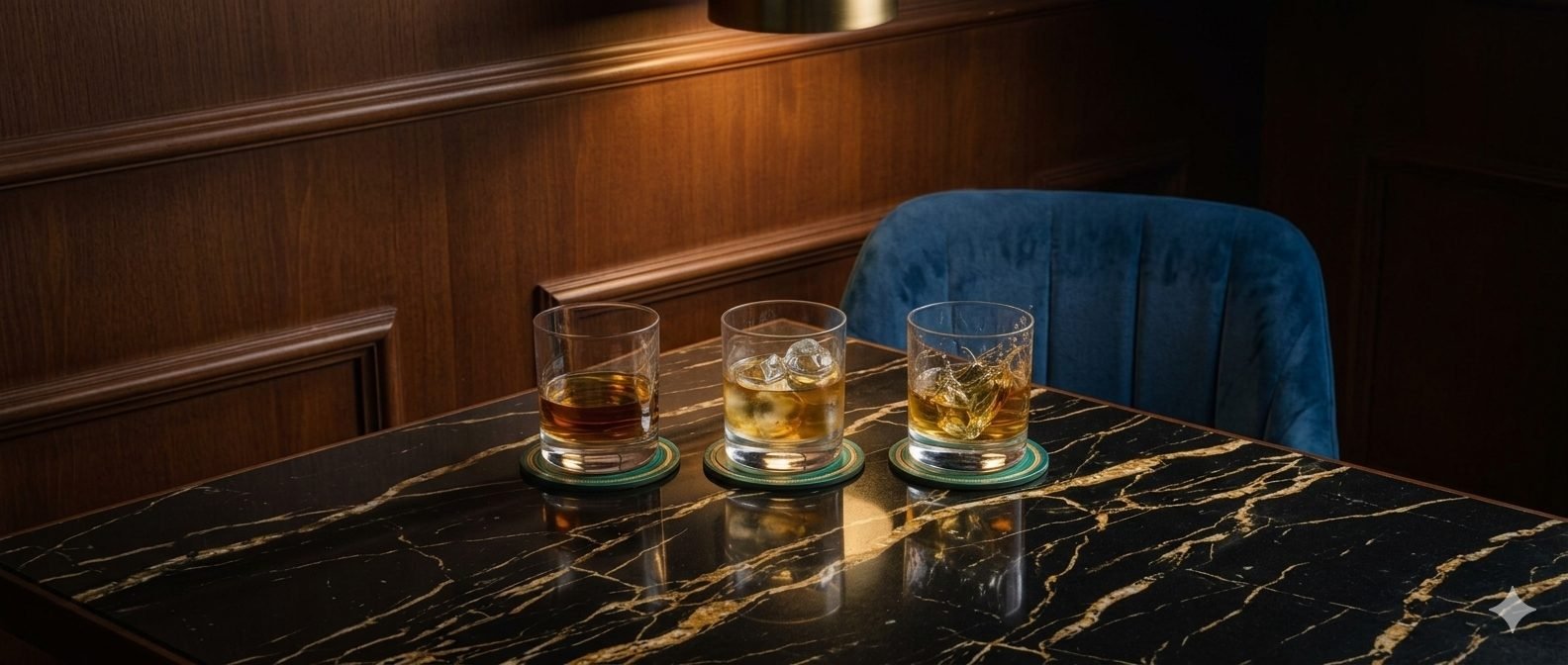
Whisky Neat, On the Rocks or With Water: What’s the Difference?
Should you drink whisky neat, on the rocks or with water? Learn what each serving style does to temperature, dilution, aroma and flavour — without the whisky rules.
You have chosen the whisky.
Then comes the second question.
“How would you like it?”
Neat?
On the rocks?
With water?
For somebody new to whisky, this can sound like a test hidden inside a drink order.
There must be a correct answer, surely.
There is not.
Each serving style changes the experience in a different way. Neat keeps the whisky undiluted. Ice cools it and gradually adds water. A small amount of water can reduce alcohol intensity and change how aromas and flavours present themselves.
None of those methods makes you more or less serious about whisky.
The useful question is simply:
How do you enjoy drinking it?
What Does Whisky Neat Mean?
Whisky neat means whisky served by itself.
No ice.
No added water.
No soda.
No mixer.
The whisky goes from bottle to glass with nothing else intentionally added.
This gives you the spirit at its bottled strength and without the temperature change created by ice.
If you are tasting a whisky for the first time, trying the first sip neat can be useful because it gives you a baseline.
You can always change it afterwards.
Why Do People Drink Whisky Neat?
Because they enjoy it that way.
That is the most important answer.
Drinking whisky neat allows you to experience the spirit without additional dilution or chilling.
This can make it easier to notice the whisky’s original aroma, texture and flavour at the strength chosen for bottling.
For people who enjoy slowly exploring a glass, neat whisky can be satisfying because the drink changes naturally as it sits and interacts with air.
But neat is not automatically “better.”
It is simply one version of the whisky.
Is Neat Whisky Too Strong for Beginners?
It can feel that way.
Many whiskies sit around 40% alcohol by volume or higher, so the first experience of drinking a spirit neat can feel intense if you usually drink beer, wine or cocktails.
That intensity does not mean you are drinking it incorrectly.
Take a smaller sip.
Give it time.
And if the alcohol sensation is getting in the way of enjoying the flavour, add water or ice.
There is no prize for struggling through a drink you would enjoy more another way.
What Does “On the Rocks” Mean?
Whisky on the rocks means whisky served over ice.
The phrase sounds more dramatic than the reality.
The rocks are ice cubes.
As soon as whisky meets ice, two things begin happening.
The temperature drops.
And the ice gradually melts, diluting the whisky with water.
Both affect how the drink tastes and feels.
What Does Ice Do to Whisky?
The most obvious effect is temperature.
Cold whisky can feel softer and more refreshing.
For some drinkers, chilling reduces the sensation of alcohol and makes the whisky easier to approach.
Then comes dilution.
As the ice melts, the whisky becomes progressively less concentrated.
That means the glass you drink after ten minutes is not exactly the same as the glass you first poured.
Some people enjoy that evolution.
The first sip is stronger.
The next becomes softer.
The whisky changes as the evening moves.
Does Ice “Kill” the Flavour?
That phrase gets repeated a lot.
Cold temperatures can make aromas seem less expressive, so heavily chilling a whisky may make some characteristics harder to notice.
But that does not mean putting ice in whisky is wrong.
If you prefer your whisky cold, then the fact that it tastes different is the point.
You are not conducting a laboratory analysis.
You are having a drink.
The better approach is to understand the trade-off.
Neat may show you the whisky more directly.
Ice gives you cooling and gradual dilution.
Choose the experience you want.
One Large Cube or Several Small Cubes?
Ice size changes how quickly dilution happens.
In general, a larger piece of ice has less surface area relative to its volume than many small pieces, so it tends to melt more slowly.
That can give you cooling with more gradual dilution.
Smaller cubes or crushed ice usually melt faster and change the drink more quickly.
Neither is universally better.
If you want a slow whisky over ice, a larger cube can make sense.
If you actively want more dilution and a colder drink, smaller ice can work perfectly well.
Why Add Water to Whisky?
Because water can change the experience.
A small amount of water lowers the alcohol concentration in the glass and can make the alcohol feel less dominant.
For some whiskies, this makes certain aromas and flavours easier for the drinker to notice.
This is particularly useful with higher-strength whisky, where alcohol intensity can initially overwhelm a beginner.
You do not need much.
A few drops can be enough to begin experimenting.
How Much Water Should You Add?
There is no universal measurement.
Start small.
Taste the whisky neat first.
Add a few drops of water.
Taste again.
If you like the change, you can add a little more.
Once water is in the glass, you cannot take it back out, so gradual is useful.
The goal is not to reach a scientifically correct dilution.
The goal is to find the point where the whisky tastes best to you.
Does Adding Water Ruin Whisky?
No.
Adding water is a normal way to explore whisky.
Remember that water is already part of the production and bottling process. Many whiskies are reduced with water before they ever reach the bottle.
Adding a small amount at the table simply changes the concentration again.
What matters is whether you like the result.
If the whisky becomes more enjoyable, the water did its job.
Neat vs Water: Which Shows More Flavour?
It depends on the whisky and the drinker.
Neat whisky gives you the spirit at bottled strength.
Water can reduce alcohol intensity and change how aroma compounds present themselves, sometimes making different characteristics easier to notice.
But too much water can also make the whisky feel thin or muted.
This is why tasting before and after adding water is more useful than memorising a rule.
Your palate can answer the question better than somebody else’s instruction.
Ice vs Water: Are not They the Same Thing Eventually?
Both dilute whisky with water, but they do not create the same experience.
Adding room-temperature water changes concentration without dramatically chilling the drink.
Ice changes both concentration and temperature.
It also changes them gradually as it melts.
So:
Water gives you more control over dilution.
Ice gives you cooling plus progressive dilution.
That difference is why the same whisky can feel noticeably different served each way.
What About Whisky With Soda?
That is another option entirely.
Whisky with soda, commonly served as a highball, turns the spirit into a longer and more refreshing drink.
Soda adds significant dilution and carbonation.
The result is lighter than drinking whisky neat or over a single cube.
Highballs can also work extremely well with food.
If neat whisky feels too intense and you want something more refreshing than whisky on the rocks, this is worth trying.
Which Method Is Best for Scotch?
There is no single correct way to serve Scotch.
Some people drink Single Malt Scotch neat.
Others add water.
Others prefer ice.
Blended Scotch can be consumed neat, on the rocks or in a highball.
The category does not dictate your glass.
If you are trying a Scotch for the first time, starting neat and then adding a little water is a useful way to understand it.
But if you already know you prefer whisky over ice, order it that way.
Which Method Is Best for Bourbon?
The same principle applies.
Bourbon can be enjoyed neat, with water or over ice.
Its often recognisable vanilla, caramel, spice and oak character can work beautifully at different levels of dilution.
Bourbon over a large cube is popular for a reason.
So is bourbon neat.
And bourbon also forms the base of classic cocktails such as the Old Fashioned.
You have options.
What About Blended Whisky?
Blended whisky is sometimes treated as though it only belongs with mixers.
That is unnecessary.
A blend can be enjoyed exactly the same ways as other whisky.
Neat.
Ice.
Water.
Soda.
Cocktails.
Some blends are designed to be particularly approachable and versatile, which can make them excellent choices for beginners experimenting with different serving styles.
What If It is an Expensive Whisky?
Drink it the way you enjoy it.
There is, however, a practical argument for tasting an unfamiliar whisky neat before changing it.
You paid to experience that whisky.
Try it first.
Then decide.
If a few drops of water improve it for you, add them.
If you prefer ice, add ice.
Price does not create an obligation to drink something in a way you enjoy less.
How to Order Whisky Neat
Very easy.
“Whisky neat, please.”
If you are ordering a specific bottle:
“Could I have the [whisky name] neat?”
That is all.
You do not need specialist vocabulary.
How to Order Whisky on the Rocks
Again:
“[Whisky name] on the rocks, please.”
If you care about the ice and the bar offers options, you can ask for a large cube.
If not, let the bar serve it in its usual way.
The drink will survive.
How to Order Whisky With Water
You can ask for the whisky with water on the side.
This is useful because it lets you control how much goes into the glass.
Try it neat.
Add a little.
Taste.
Add more only if you want it.
You can also simply ask the bartender for a small splash of water.
There is no required ceremony.
The Best Beginner Experiment
If you genuinely want to understand the difference, use one whisky.
Do not compare three completely different bottles.
Pour or order the same whisky and experience it in stages.
First, taste it neat.
Then add a few drops of water.
Notice what changes.
On another occasion, try the same whisky over ice.
Which version do you prefer?
That simple experiment teaches you more about your own palate than reading twenty arguments online about the “proper” way to drink whisky.
Whisky and Food
How you serve whisky can also depend on what you are eating.
Neat whisky can be intense beside lighter dishes.
A whisky with a little water may integrate differently with food.
Whisky over ice can feel more refreshing with rich dishes.
A highball can be particularly food-friendly because its dilution and carbonation make it lighter on the palate.
There is no need to force one serving style across an entire meal.
Whisky With a Burger
At The Bank, this is an obvious pairing to talk about.
A rich burger can stand beside whisky surprisingly well.
Beef, cheese, salt, fat and caramelised flavours provide plenty for the spirit to work with.
If neat whisky feels too intense alongside the food, ice or a highball can make the combination more relaxed.
An Old Fashioned is another natural option because it keeps whisky at the centre while adding sweetness, bitters and dilution.
And if you would rather have beer with your burger, we will not be offended.
Neat Whisky vs an Old Fashioned
An Old Fashioned is useful for somebody who likes whisky flavour but wants a more structured drink.
The whisky remains central.
Sugar adds sweetness.
Bitters add seasoning.
Ice and stirring provide dilution and chilling.
It is a cocktail, but one that still allows the base spirit to speak clearly.
For some people, the Old Fashioned becomes the bridge between mixed drinks and whisky served on its own.
What About a Manhattan?
A Manhattan takes whisky in another direction.
Sweet vermouth and bitters add richness, aromatics and complexity.
Compared with whisky neat, the drink is obviously more transformed.
Compared with many cocktails, however, the whisky still has a strong presence.
Trying whisky neat, an Old Fashioned and a Manhattan can be a very enjoyable way to understand how one category of spirit behaves in different formats.
Whisky at The Bank Bar & Burgers
At The Bank, we do not have a preferred answer when somebody asks how whisky “should” be ordered.
Some guests drink it neat.
Some ask for a large cube.
Some want water.
Some order highballs.
Some want an Old Fashioned.
Some want a Manhattan.
The right answer changes from person to person and sometimes from night to night.
That is normal.
So, Neat, Rocks or Water?
Here is the simplest version.
Choose neat if you want to experience the whisky at bottled strength without chilling or intentional dilution.
Choose on the rocks if you enjoy a colder drink and gradual dilution.
Add water if you want to reduce the alcohol intensity while keeping the whisky closer to room temperature and controlling the dilution yourself.
Choose soda if you want something longer and more refreshing.
Choose a cocktail if that is what you actually feel like drinking.
None of those choices makes you more knowledgeable.
Knowing why you prefer one of them is the useful part.
Stop Worrying About the Correct Glass
Whisky attracts rules.
Some are useful.
Some help explain production.
Some help with tasting.
And some simply make beginners nervous about ordering a drink.
You do not need permission to add ice.
You do not need to apologise for adding water.
You do not need to force yourself to drink whisky neat because someone at another table thinks that is more sophisticated.
Try the whisky.
Change it.
Try it again.
Then order it the way that makes you want the next sip.
That is the difference that actually matters.
New to whisky altogether? Start with our beginner's guide to whisky, or explore our menu and promotions.
Try the whisky. Change it. Try it again. Then order it the way that makes you want the next sip.